How to Identify and Improve Management Competency Gaps
In organizations, managers plan, coordinate and organize processes or people. Businesses assign
managers to oversee business functions including operations and production, risk, human
resources, finance, sales, information technology, marketing and accounting.
Some managers specialize in carrying out a narrow set of management tasks. Other managers
manage across many tasks. For example, typically, small business managers take responsibility
for multiple tasks, but managers employed by large businesses have specialized tasks assigned to
them.
Persons with managerial responsibilities often have the skills needed to manage one business
function very well or the competencies to do multiple functions well. Especially when asked to
oversee multiple functions, managers often have gaps between their competencies and job
demands. Successful businesses provide managers with tools to identify competency gaps, and a
successful manager will embrace competency gaps and seek out alternatives — opportunities to
improve or seek support from others to fill the gaps.
Borrowing Management Principles from Baseball
Managing a business and filling a baseball team’s roster share similarities, so consider the
following analogy. Just as a business calls on managers with different competencies to fit roles, a
baseball team needs three types of players to compete and win: skill players, role players and
utility players.
Calling on “Utility Players” as Small Business Managers
Like a baseball team, businesses require a variety of management styles and skills to succeed. In
a small business, however, one manager may have multiple assigned tasks related to developing
the enterprise, creating or capturing value and making management decisions. This type of
manager functions like a baseball team’s utility players.
Small food businesses may push the utility player metaphor even further. For example, the food
business manager in some cases also carries the farm business manager title. Managers of value
added enterprises sometimes make decisions to complement the corresponding farm businesses.
At other times, they assume new tasks different from those needed to run the farm. Sometimes,
an individual forming a value-added business may be new to farming and would need to learn
farm management and food business management tasks.
Managers tasked with diverse responsibilities often benefit from placing a deliberate focus on
upskilling their management capabilities. First, however, they must understand where they excel
and where they have competency gaps.
Assessing Your Own Management Capabilities
The Management Resiliency Self-Assessment helps users to identify gaps in their management
competencies. The tool recognizes how management needs vary by farm and food enterprise,
and it accounts for management functions most necessary for an enterprise to succeed.
For example, functions necessary to successfully grow peppers and then sell them to restaurants
include marketing and finance, whereas functions necessary to grow switchgrass and deliver it to
a bioenergy company include production and finance.
By completing the self-assessment, managers begin to appreciate their managerial strengths and
weaknesses. Using this information, they can decide where their skills best align in meeting a
farm’s management needs, and they can pinpoint the managerial skills they would most benefit
from improving or outsourcing.
Ranking Your Own Functional Business Competencies
Using the Management Resiliency Self-Assessment, you will evaluate your competencies related
to as many as five business functions: production and operations, financial, labor, sales and
marketing. To complete the assessment, you will rank 15 to 25 statements on a scale from “1” to
“10” using a slider. Listed in no particular order, each statement relates to one functional
business competency. The following three examples are statements included in the assessment:
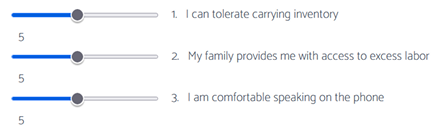
Assigning a “1” indicates you strongly disagree with a statement. A “10” indicates you strongly
agree. The default rank is set to “5,” which represents indifference to a statement and controls for
status quo bias — the tendency to accept the default presented. By using “5” as the default, the
tool minimizes a tendency to underestimate or overestimate rankings.
After assigning ranks to each statement, select “Calculate Results.” Your rankings will be
tabulated into functional competency scores.
Interpreting Your Functional Competency Scores
On the scoring page, you will see a competencies summary; the table below shares an example.
The specialty crop, alternative crop and animal products categories have five management
competency scores. Bioenergy crops and cover crops have three management competency
scores. Each functional area has a maximum competency score of 50.
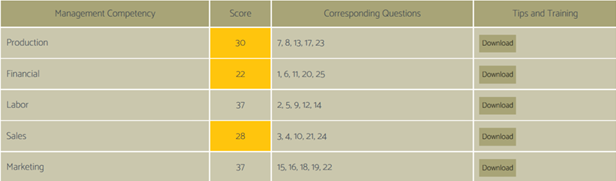
The tool treats 35 points as the competency score threshold. It assumes a manager must score at
or above this threshold to succeed in managing a particular business function. Not chosen
arbitrarily, this threshold recognizes that a small business owner should be comfortable with
managing multiple business functions. It recognizes that irrational exuberance — excitement to
do something without thinking through things first — gets the best of us. Scores above or below
the 35-point threshold are intended to temper irrational exuberance and force people to be honest
with themselves about their strengths and weaknesses.
After reviewing your scores, refer to the informational tips and training resources, particularly
for categories where your score was less than 35, which have scores highlighted in gold. These
resources will help you explore more about a particular functional competency. Based on your
scores, you may decide to self-learn a new competency, enroll in a short course or visit with an
expert. If you realize you don’t have passion for a particular function or the time to improve a
function, even if it’s one you enjoy, you may choose to outsource — find an employee or partner
who would offer management competencies the business needs but you yourself cannot provide.
Managing A Business Like a Utility Player Approaches Baseball
When considering your assessment scores, keep in mind these five pointers.
- No assessment can capture all aspects of successful business management.
- Engaging a highly competent manager does not mean a business will succeed because
external forces also influence business success. - A business may succeed without a highly competent manager — again, because external
forces shape business success. - A manager does not have to be great at all business functions. This is especially true for a
single-manager small business. - Most importantly, good managers will recognize, and even accept, their competency
gap(s) and shore up these gaps by engaging other managers who complement skills gaps
that exist in a business.
If you decide to build a team to fill managerial competency gaps, then this process can be easy or
hard. It’s up to you as the manager. After acknowledging where you have competency gaps,
identify a spouse, child, cousin, parent or friend who may offer competencies that aren’t your
strengths. Outsourcing specific functions where you lack expertise may allow you to focus on
your strengths and help the business to perform better. When deciding who should fill the gap,
remember three factors: 1) whether you place trust in someone, 2) your passions as the owner
manager and 3) risk to the business if the competency gap is not addressed.
In our experience, managers most comfortably self-identify finance and accounting as a
management competency gap. Because most persons steer away from numbers, outsourcing the
finance and accounting function is socially acceptable.
Managers feel least comfortable naming production and operations as a management
competency gap. Farmers, including those focused on value-added endeavors, especially tend to
be uncomfortable with self-identifying production and operations as a management gap.
When self-evaluating skills and competencies, passion often clouds judgment. We may feel
biases against admitting we are not so good at a function that relates to our passion. However,
the most successful small food businesses have managers who openly identify their management
capability gaps, even if that means recognizing that a passion is a weakness.
As you think through staffing your own business and choosing a management team, remember
this. A successful utility infielder appreciates a World Series ring just as much as the teammate
who’s named an All-Star first baseman. Both contributed to winning the World Series.